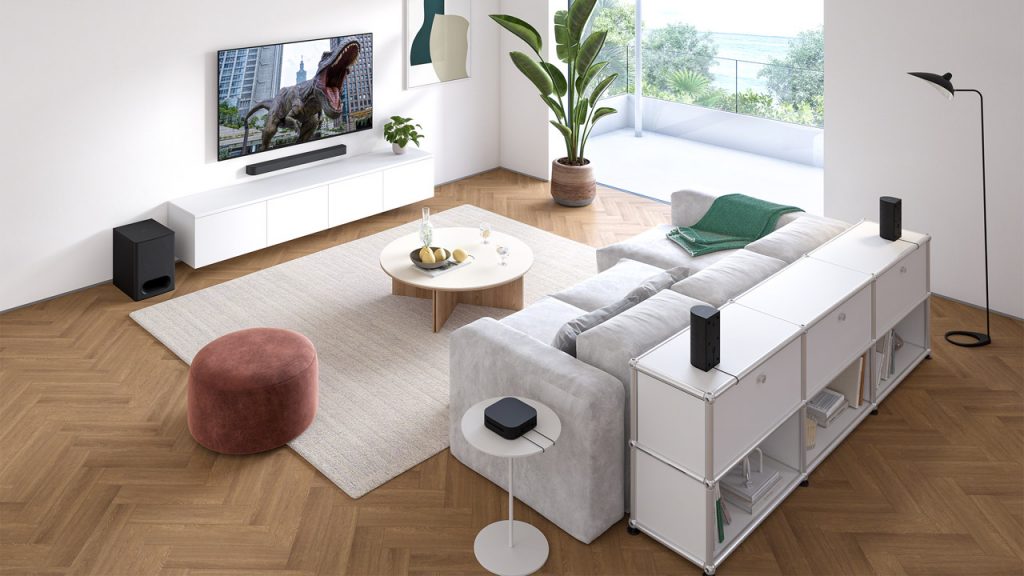
When it comes to building your home theater, the sound system can make or break the whole thing and in 2026, picking the right one hasn’t gotten any easier.
The shape of your room, the height of your ceiling, the distance from your couch to your TV, even the type of flooring you have: all of it factors in. Sony is doing its best to take some of that off your shoulders with the BRAVIA Theater System 6.
Sony is no stranger to home audio, and a complete 5.1 surround system in one package isn’t new to this market either. For better or for worse the System 6 does a few things most “all-in-one” surround systems don’t, and nearly all of them come down to its subwoofer.
Sony made that sub the focal point of this system in more ways than one. It punches well above its weight class, and it’s also where the rest of the system plugs in. It’s the home base as much as it’s the home bass.
Most soundbar configurations have you plug power and your chosen audio connection into the bar itself, then to the TV and make the connection from sound bar to subwoofer wireless. Alternatively, Sony has you plug everything into the back of the sub. From there, the soundbar connects directly to the sub with its attached 10-foot cable.
Two things make that setup more problematic than it sounds. The included HDMI cable is only about five feet long, which ties the 25-pound subwoofer to the TV unless you go buy a longer one, and the connector at the end of the bars wiring is proprietary, so 10 feet is your hard cutoff.
This setup makes System 6 a very wired “wireless” home theater choice. The only wireless link in the chain is the signal from the sub to the rear speaker receiver, and that receiver still needs its own wall outlet near your seats. Having the rears separated from the main hub does help keep tripping hazards down, but if your seating isn’t up against a wall with a power outlet, you may find yourself with that hazard anyway.
When it comes to performance, the star of the show is easily the oversized subwoofer, which delivers punchy, powerful, clean bass even in the busiest movie scenes. My go-to test is the Batmobile chase from The Batman. Even with the rumble of the car layered over heavy gunfire and a blasting score, the sub never flinched, it kept its cool from start to finish.
The “surround” part of the surround sound comes from two rear speakers that plug into a powered receiver. During setup, the instructions assure you there’s no dedicated left or right speaker — they’re identical until you plug them into the box.
It’s also worth noting that while Dolby Atmos and DTS:X are both supported, there are no up-firing drivers. For nearly the same price, Sony’s own Theater Bar 6 keeps the up-firing drivers and drops the rear speakers instead.
Where the sub shines, the soundbar and rear speakers left me wanting. They were adequate, but nowhere near as impressive as the sub. Dialogue clarity was about average, and in busier scenes the rears felt like they were doing too much. There’s a level adjustment for them, but no matter where I set it, I could never get them quite where I wanted.
After tinkering with the rear level adjustment for a while, I went digging through the rest of the companion app looking for an EQ and came up empty, and this is really where things started to go downhill for me. The only level adjustments are bass and rear speakers. Beyond that, you get the standard presets Night, Voice, and “Sound Field,” which toggles the virtual surround processing.
In a system that costs $800, that lack of customization is a shock. Anyone willing to spend that much on a home theater system probably has opinions about how it should sound.
While we’re on the topic of features this system lacks, it also has no Wi-Fi at all, which means no AirPlay, no Chromecast and no Spotify Connect. If you want to play music through it, you’re on Bluetooth or whatever app you chose to run through your TV. Not exactly a dealbreaker by itself, but in 2026 this is standard on many systems.
That’s really where this setup runs into a brick wall: the System 6 has almost no personalization available. Sony wants you to set it up and leave it as is, there’s little to no room for getting it just right for you, even when it comes to its stringent predetermined layout.
For example, if you live in a condo or apartment, placing the sub against a shared wall might not be the best setup, but if your TV is already there your only choice is to swap your entire layout or risk getting a harshly written letter slipped under your door.
Plenty of competing systems make room layout and customization a central part of setup. JBL, LG and Samsung all use a microphone on your phone, the bar, or the TV to map your room before you press play on your first movie. Sony skips the microphone entirely, asking you to pick your speaker distances from a preset list instead.
That’s not to say System 6 won’t make someone happy or improve movie night. But if you want a little more personalization and a few less wires in your “wireless” setup I’d look elsewhere.
Soundbar-based surround systems are supposed to make buying individual speakers for a receiver a thing of the past, putting a high-end home theater experience within reach of anyone. In a lot of ways, System 6 does exactly that. But at $800, Sony goes a bit too far with its one-size-fits-all approach.